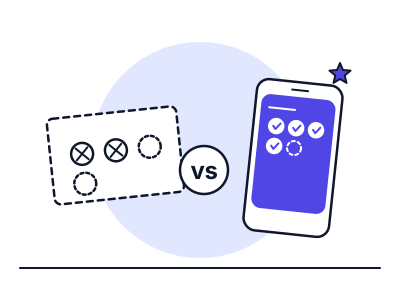
Paper cards are cheap and familiar, but they get lost, give you no data and cannot reach lapsed customers.
A digital stamp card lives in the phone wallet, updates instantly and shows who is close to a reward.
Paper can still make sense when most of your customers are not confident with smartphone wallets.
Switching takes a few steps: choose the mechanic, brand the pass, place QR codes and honour existing paper progress.
The Case for Paper Stamp Cards
Paper loyalty cards have worked for decades. They are cheap to print, easy to hand out, require no technology, and every customer understands how they work immediately. For a new business with limited budget and no time for tech setup, a paper stamp card can be live in hours.
The simplicity is genuine. Your staff hand a card to each customer, stamp it at each visit, and reward them when it's full. No passwords, no apps, no QR codes. For very small operations with regular face-to-face customers, this can be entirely adequate - at least to start.
The Problems With Paper Loyalty Cards
The limitations of paper cards become obvious quickly. Cards get lost - the customer who was seven stamps in now starts again from zero, which creates frustration rather than loyalty. Cards get left at home, which means the customer skips the programme entirely on a given visit. And some customers simply forget they have a card at all.
The bigger problem is invisible: paper generates no data. You have no idea how many active loyalty customers you have, which ones are close to a reward, when someone last visited, or whether the programme is changing behaviour at all. You are running a loyalty programme completely blind.
There is also a fraud dimension. Paper cards can be stamped by anyone with a similar pen, photocopied, or shared between customers. Without any audit trail, abuse is difficult to detect and almost impossible to prove.
And when you want to change the offer - adjust the stamp count, launch a seasonal promotion, or update the reward - you reprint. Every time. That print cost and lead time adds up across a year, especially for businesses that want to keep the programme fresh.
What a Digital Stamp Card Fixes
A digital stamp card stored in Apple Wallet or Google Wallet addresses every one of those limitations. The pass is on the customer's phone, which they almost certainly have with them at every visit. It cannot be lost separately from their phone. Stamps are issued digitally and are device-bound, making forgery and sharing effectively impossible.
The data transformation is the most significant change. From day one, you can see how many customers have joined, how many are active, what their average visit frequency is, and how many are close to redeeming a reward. That means you can act: push an offer to customers who are one stamp away, send a reactivation message to someone who hasn't visited in four weeks, or double-stamp on a quiet Wednesday to fill the diary.
Updating the programme costs nothing. Change the stamp target, add a seasonal offer, or create a new card type - it is live on every existing pass instantly, without a reprint or a phone call to a printer.
Digital vs Paper: Side-by-Side Comparison
Factor
Paper stamp card
Digital stamp card app
Setup cost
Design + print cost
Monthly subscription, no print
Lost by customer
Common - restarts from scratch
Pass stays on phone
Forgotten at home
Frequent barrier to use
Always in their wallet
Fraud prevention
Easy to fake or copy
Device-bound, full audit trail
Customer data
Zero
Join rate, visit frequency, redemption
Targeted offers
Not possible
Push by segment, behaviour, date
Programme changes
New print run required
Instant update, no cost
Environmental impact
Ongoing paper waste
Fully paperless
Setup time
Hours
Minutes to days
When Paper Cards Still Make Sense
Paper cards remain a reasonable choice in a handful of situations. If your customers are predominantly older and not confident with smartphone wallet apps, a paper card may see higher participation - at least initially. If you have no budget at all and need something in place today, a basic paper card is better than nothing.
Some businesses also use paper cards alongside digital: the paper version for walk-in customers who are not ready to add a wallet pass, with digital available for those who prefer it. This dual approach captures more participants but requires managing two systems.
The honest summary is that paper cards are a good starting point and a poor long-term solution. Once you have a loyalty programme running, the lack of data makes it almost impossible to improve. The cost of switching to digital is typically recovered within months through better retention and more targeted promotions.
How to Switch From Paper to Digital Stamp Cards
Switching from paper to digital is simpler than most business owners expect. You choose your loyalty mechanic (stamp, punch or points), set the reward rules, brand the pass design, and generate a QR code for your counter. Most platforms, including Ruloyal, let you honour existing paper card progress by issuing stamps manually to customers who convert.
The most effective transition approach is to run both in parallel for four to eight weeks. Promote the digital pass actively - a small sign at the counter, a line on receipts, a post on your social channels - and let customers choose. Most switch naturally once they see the wallet pass on their phone. After the transition period, you retire the paper cards.
Key steps: choose a platform, configure your first programme, place QR codes at all customer touchpoints, train your team on stamp issuance, and monitor the dashboard to see join rate grow.
Choose platform and configure loyalty mechanic (same as your paper card)
Brand the digital pass with your logo and colours
Place QR codes at counter, tables and on receipts
Honour existing paper card progress during transition
Monitor join rate and redemption in the analytics dashboard
Frequently Asked Questions
Are digital stamp cards better than paper?
For most UK small businesses, yes. Digital stamp cards outperform paper on customer retention (no lost cards), data (full analytics), fraud prevention (device-bound stamps) and cost flexibility (no reprints). The main advantage paper retains is simplicity for tech-averse customers.
Do customers prefer digital or paper loyalty cards?
Younger customers (under 45) typically prefer digital - it is one less card to carry. Older customers may initially prefer paper. Many businesses run both in parallel during a transition, then retire paper once digital adoption is established.
How long does it take to set up a digital stamp card?
With a platform like Ruloyal, most businesses can configure and launch a digital stamp card in under a day. Basic setup - loyalty mechanic, reward rules, branding - takes one to two hours. The QR code can go on the counter the same day.
Can I convert my existing paper card customers to digital?
Yes. You can issue digital stamps manually to customers who show their existing paper card, matching whatever progress they have accumulated. This lets you honour existing loyalty without customers feeling they lose their stamps in the switch.
How does a digital stamp card work better than a physical stamp card?
A digital stamp card cannot be left at home or lost, updates the moment a stamp is issued, and gives you data on visits and redemptions that a paper card never can. It can also remind customers when they are close to a reward. Paper still wins on pure simplicity, which is why the switch works best when signing up takes a single scan.
Written by Kate (Founder, Ruloyal) and George.
Last reviewed 27 August 2026. Read how we research and review our guides in our
editorial standards.
A digital loyalty card, also called an electronic or virtual loyalty card, is a reward card on your phone. How it works, its benefits and how to launch one.
Step-by-step guide to setting up a cafe loyalty programme for UK cafés. Choose the right mechanic, launch a digital stamp card and grow repeat customers.
Launch your first digital stamp card in minutes. No printing, no app download, no hardware - just a QR code at your counter and a dashboard on any device.